Start Small


Inspired by a number of projects I’ve seen that focus on high street shops, I set off with optimism, aiming to photograph shopkeepers and interview shoppers or begin a journey towards that. The resulting images with transcribed text I hoped would capture snapshots of life in South West Burnley.
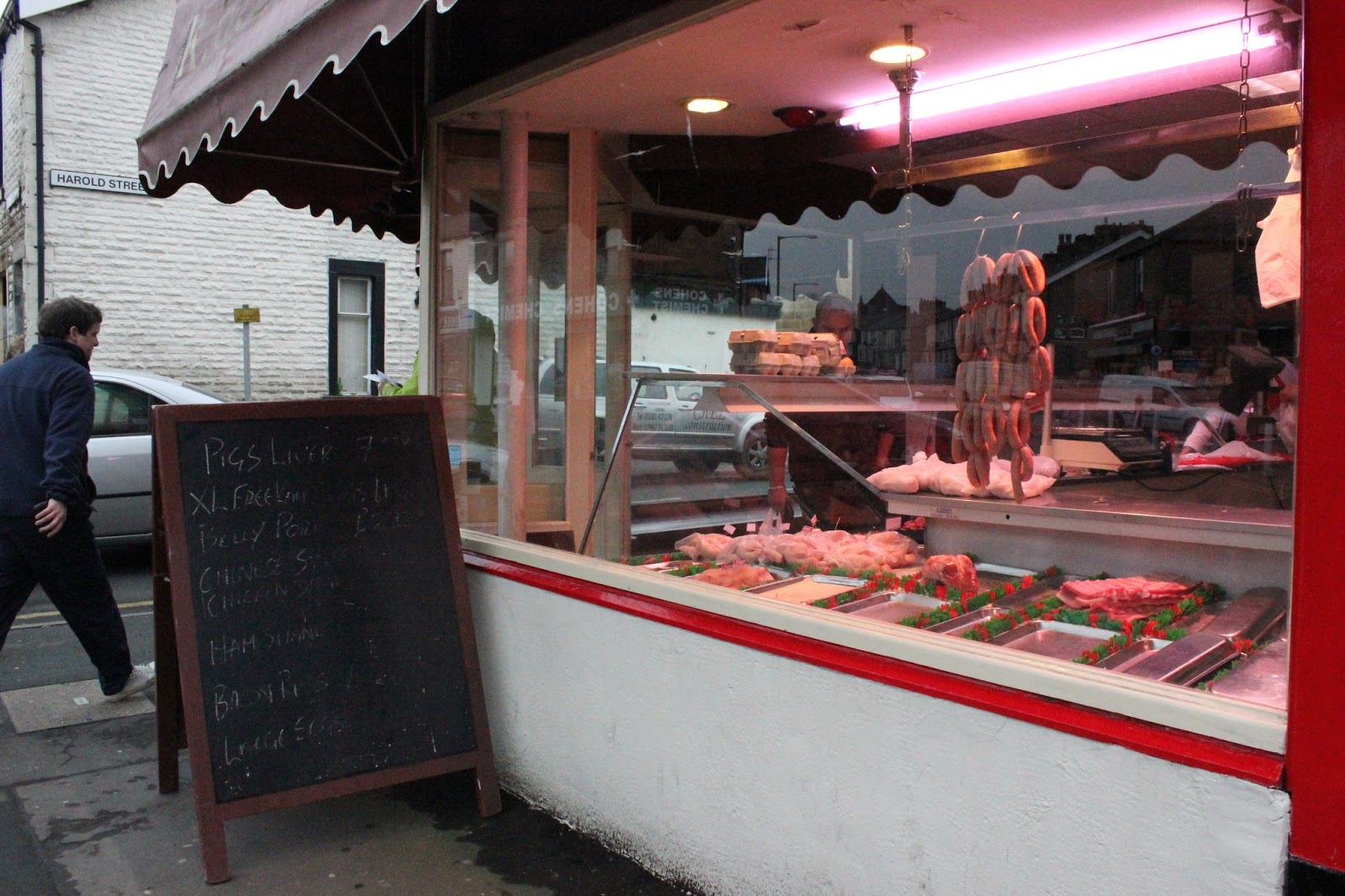

Butchers

Newsagents
 

A methodology sometimes used in qualitative research involves ‘purposive’ or ‘snowball’ sampling whereby one respondent recommends the next person the researcher should talk to. Taking this approach, I asked Susan in the Library to suggest the next person I should chat to and she recommended one specific shopkeeper whose business had thrived for decades. ‘Have you time for a chat?’ I asked, ‘nah, too busy, too busy’ he replied. ‘Can I take your photo?’ again no and especially not if it was to be published on a website. I wondered about trust and openness and the weight of suspicion and how it might be countered.  Who else should I talk to? ‘Try Kathleen the Florist’. And off I went.

Kathleen's Florist


Picture this: a vibrant local florist shop on the Friday afternoon before Mother’s Day. Workers in high visibility vests contemplated pots over bouquets, carnations over roses with Kathleen amongst them patiently giving her advice. This was not a shopkeeper with time on her hands! With friendly encouragement I snapped away, collecting images of the shop and next door’s green grocer’s.  I’m looking forward to visiting again.

Steph 09.03.13


First rule: gatekeepers


Ground UP is about exploring sense of place and asking questions such as ‘What makes South West Burnley different?’ and ‘What is special about South West Burnley?’ Studying people and place in South West Burnley however has its own particular tensions, especially when discussion moves on to consider change. Unfortunately for some people, asking them what makes South West Burnley different from other places elicits some very negative perceptions about the area or rather what it has become.

On Friday afternoon I set out from Coal Clough Library, camera in hand, with the intention of striking up a few conversations, capturing some images and maybe, if I was lucky, recording an interview or two. Susan at the Library was incredibly supportive and offered me a little space where I could invite people to join me for a chat.

Coal Clough Library


Now, using a digital SLR camera on a residential high street is not the most subtle approach an ethnographer might employ, but based on experiences I’d had late last summer, I naively imagined that the camera might draw a bit of interest. When I was last out and about with a camera, people were sitting on the low walls outside their houses, chatting in groups: quick to stop me and ask, ‘are you from the council?’ or ‘are you a student?’ but crucially giving me the seed from which a conversation could grow. 

Coal Clough Lane


An icey wind-blown day in March was sadly a less hospitable environment for idle, playful chats. One resident, we’ll call her June, was keen to tell me about the changes she had seen over her 30 years in the same house, and the transformation of the street as her old neighbours moved away to be replaced by a proliferation of (largely absent) private landlords. It felt to me almost as if she was struggling to take a position in relation to the shifting social dynamic, where at once she seemed to condemn the ways of her new neighbours, she quickly rounded to boast about how the younger men looked after her ‘Are you OK, we’re going into town, do you need any shopping?’

Low walls and front gardens, places to stop and chat


June clutched her dressing gown around her and sucked on a cigarette as she stood in the front doorway of her house. ‘Would it be OK if I came and recorded a chat?’ I asked, but no, instead our conversation occupied a strange space between June's garrulous geniality and her restraint bordering on suspicion. I strained to catch what she had to say, leaning over the wall, the wind causing tear drops to stream from my face. On three occasions as we chatted, she shouted greetings to passers-by, ‘Do you know a lot of people round here?’ I asked. ‘Oh yeah, I know everyone.’

Where to next? I need to be introduced by a person of trust. First rule of enthnography: gatekeepers.
Steph 08.03.13

Ground UP's visit to Anfield


Is it really possible to know a place if you have never lived in it? Existential philosophers have expressed an interest in sense of place as 'lived experience'. They wanted to get to the very essence of place through a study they called phenomenology.

On Wednesday last week, Cath, Iain and I hopped on a minibus in Liverpool and came screeching, slap-bang, face to face with a tale of lived experience so heartbreakingly poignant and electrifyingly angering that we have been able to think of little else this week.   

We didn’t live in that place, but through an incredible artistic intervention we certainly experienced its phenomenology.


 This was the Anfield Home Tour. Originally commissioned as part of Liverpool Biennial, the tour is a careful weaving of personal experience, literary talent, comedic improvisation and theatrical direction that combine to tell a story, or many stories, of life in an area of housing market renewal.


The tour reveals tension between insider and outsider accounts of Anfield's situation; the resulting 'insider' narrative is so rich in colour and texture that lived experience in Anfield is brought into sharp focus.

Housing Market Renewal arrived in Anfield some fifteen years ago. As ‘Carl’ our tour guide pointed out – the emphasis here is upon housing market renewal, not community renewal. In his view, this has been a project entirely focussed on the future with little regard to the ‘now’. The gleaming Keepmoat future has yet to arrive for many who continue to live in Anfield, in a diverse housing stock of Victorian terraces, some humble, some grand: five bedroom redbricks with period features. These are the houses Phil and Kirsty dream of except for their ‘location, location, location’. Because in Anfield residents have been told their location is one of deprivation, undesirable, and their houses not good enough. 

Conversely, as Jayne Lawless explained when our minibus parked outside what was once her family home, “we didn’t feel deprived”. 
 
 Here stood the now ‘tinned up’ terrace in which Jayne’s parents raised their family, both worked and Jayne had a comfortable home in a safe and caring community. When they were just five years away from paying off their mortgage, Jayne’s parents were forced to sell through compulsory purchase order. They didn’t get a fair price and, for their new home, they had to take on more debt which Jayne will be liable for when they pass away. 


As did Bob, who climbed on board our minibus outside what was once his home. A DIY enthusiast, he’d invested in his house over many years, only to watch the damp creep in when surrounding properties fell empty and the council failed to make them watertight. Hospitalised with pneumonia, kids setting fire to empty houses on his street, he was finally delighted with his relocation. He chose not to dwell on the money he lost in the transaction and the fresh debt he’ll pass on to his offspring.


On and on the tour went, with one resident’s story layered upon another until finally we were asked inside Sue’s house. Bought by her grandma in 1920, she described the ways in which her family had modernised and in turn restored this beautifully presented home. A compulsory purchase order has hung over it for years and Sue still doesn’t know if she is staying or going.   

She hangs on as her surroundings fall into the ‘controlled decline’ of absentee private landlords, antisocial tenants and neglected empty houses from which flora grow through into the walls of Sue’s loft space. Sue was barely able to conceal the emotional pain and burden of stress this has weighed upon her for no small number of years.
At the conclusion of our tour, we disembarked at Homebaked. Here over hot tea and fresh bread, we were reunited with all of this story’s characters and they explained what they plan to do next…
  
HOMEBAKED
Jeanne van Heeswijk has been working with the community in Anfield for the last two and a half years. Through the 2Up 2Down / Homebaked project the community can take matters into their own hands. Here the community have come together to reuse a block of empty property made up of a former bakery building and two adjoining terraced houses.


They have set up the Homebaked Community Land Trust, a cooperative organisation with its roots in the garden city movement. This will enable the collective community ownership of the properties and the reopening of the Bakery as a social enterprise.

Visit the Homebaked blog to see what they're up to


Thinking at The Fold - a planning meeting blogged by Steph.

Yesterday myself, Cath and Iain spent the day at The Fold doing a bit of planning. It was great to spend time together exploring ideas and charting a path towards achieving our objectives.  We were pleased with the feeling of rapport that has developed between us and we're enjoying working as a team. Chocolate fingers, ginger cordial and plenty of tea oiled our creative wheels as we thought about how to stimulate residents to think and talk about local sense of place.

This put me in mind of research conducted by John Dixon and Kevin Durrheim (2000). They looked at sense of place through the lens of social and environmental psychology, pointing out that our identity is closely related to context and place. They described this as the located nature of subjectivity. They thought place was incredibly important in our creation and maintenance of a sense of ourselves. More interestingly they also pointed out the value of conversation in lifting the notion of sense of place from ‘the vaults of the mind’ to the ‘foreground of human dialogue’. This is what we want to get up to in South West Burnley!

But how to start those conversations? One idea that we’ve bounced around for weeks has been to procure an old, quirky vehicle that we could adapt into a touring ‘pop up’ museum. We imagined parking up in any number of spots in South West Burnley, sparking the curiosity of passers-by and offering them a cup of tea. Then we’d invite them to step inside and visit our museum, hopefully donating a memory, photo or object as they did so.

Our planning day helped us to realise that we actually want to invest in more sustainable activities – events that bind people together, bridging the differences between groups and levering in support through some of the services operating in South West Burnley – this would leave behind stronger relationships and networks instead of an old vehicle requiring tax and MOT!

So we started brainstorming. We don't want to give too much away but here's some clues: we’ll be searching for Eric, hunting ghosts, planting and growing, exploring water underground, mythmaking, and possibly 'pap'ing!…. Curious? Watch this space!

If you want to be involved, why not message us on facebook or contribute to the South West Streets Museum?


Dixon and Durrheim - British Journal of Social Psychology - BRIT J SOC PSYCHOL , vol. 39, no. 1, pp. 27-44, 2000

Flower Walk for Life Poster

Drawn by Iain, coloured in by Cath. A creative collaboration of the simplest kind!

We Love Our Community Centre II

The banner seemed to be an effective tool for starting conversations and profiling the community centre's campaign to save their centre, so Chris asked if I would be able to do an illustration for a series of cards which would help them to spread the message and the art even further.
Happy to and I hope it helps!